How to Start a Skincare Range Without Expensive Mistakes
Starting a skincare range is exciting. It is also very easy to spend money in the wrong places too early.
People often begin with the fun parts:
logo → packaging → colours and design → bottle → hero ingredients.
There is nothing wrong with thinking about how your range will look. But this is really the middle of the process, not the beginning.
Before choosing bottles, designing labels or developing formulas, start with two questions:
Who are you selling to?
How are you going to sell to them?
Once those are clear, product selection, branding, packaging and budget become much easier.
1. Start with your customer
Who are you actually creating the range for?
Try to be more specific than “women who care about their skin.”
If you are a clinic
Your customer may already be sitting in your treatment room.
Perhaps they are clients having professional treatments who need simple supportive homecare between appointments. That already starts narrowing which products make sense.
If you are starting a skincare brand
Perhaps your target customer is a busy woman with dry or sensitive skin who shops mainly online and wants a simple routine.
That is very different from creating skincare for teenagers with oily skin or a premium range sold through high-end clinics.
Once you understand your customer, research several successful brands already speaking to a similar audience.
Look at:
- the products they lead with
- their packaging and visual style
- the language they use
- their price position
- the problem they appear to solve
Do not copy them. Use the research to understand what your target customer already responds to and where your own range could be different.
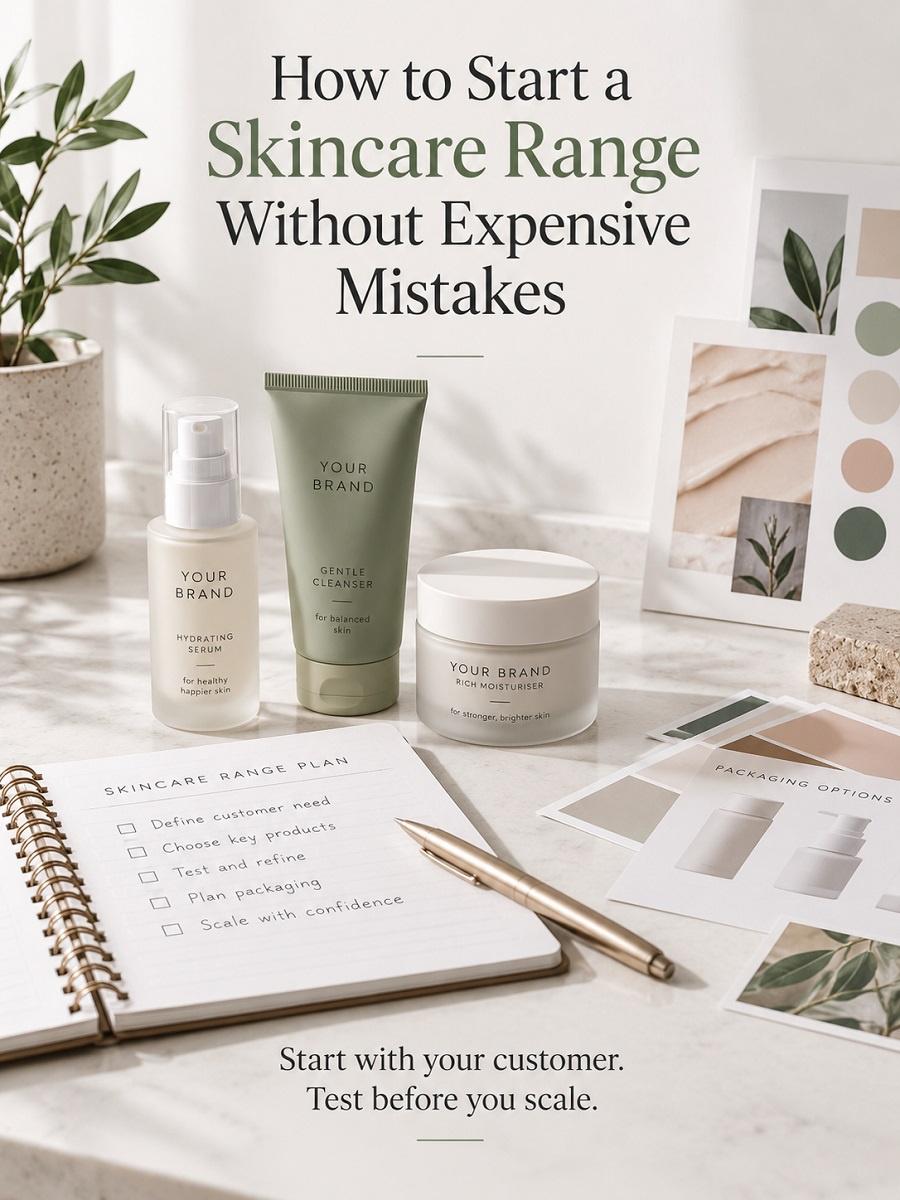
A simple mood board can help. Save colours, packaging styles, product names and design ideas you like. This will make conversations with a designer or manufacturer much easier later.
2. Decide how you are going to sell it
Next ask:
Where will your customers actually buy the products?
Will you sell:
- inside your clinic?
- through your website?
- through platforms such as Amazon?
- through social media?
- at markets?
- through gifting platforms?
- through more than one channel?
This affects how much stock you need, what products make sense and where you need to focus your first efforts.
Example: an established clinic
If your clinic already sees 100 clients each month, you already have an audience.
You can introduce products during consultations or after treatments, explain how they fit into homecare and quickly learn what clients are interested in.
Example: a new online skincare brand
If you are starting online with no existing audience, your biggest challenge may not initially be manufacturing.
It may be getting people to discover the brand and trust it enough to buy.
That could mean launching fewer products and keeping part of your budget available for actually reaching customers rather than putting most of it into stock.
Your first budget should not all go into products. You still need a way to sell them.
3. Choose the smallest range that makes sense
Once you know your customer and sales channel, choosing products becomes much easier.
You do not need six, eight or ten products to look established.
A clinic might start with a cleanser, targeted serum and moisturiser.
A new skincare brand might be better launching one strong hero product or a small routine built around a specific skin concern.
This is also a good time to look for an Australian skincare manufacturer offering low minimum order quantities (low MOQ) and request samples of products that may suit your range.
Consider ready-to-brand skincare before developing from scratch
Ready-to-brand, often described as private label or white label skincare can be a practical way to launch without making a large investment in custom formulation from day one.
The formulas have already been developed, reducing much of the time and development work involved in starting from scratch.
Order samples from a low MOQ skincare manufacturer and evaluate:
- The formula
Texture, scent, ingredients and how it feels on the skin. - The cost
Pricing at the quantities you realistically want to order. - The manufacturer
Are they easy to communicate with? Are lead times clear? Do you feel comfortable asking questions? A good manufacturing relationship should support you beyond the first order. - The support available
Can they help with label design, printing, packaging options and regulatory information? - Future flexibility
What happens if you later want to add products, change direction or move into custom formulation? - Quality standards
Look for a manufacturer certified to ISO 22716 and ask to see certification. The international Good Manufacturing Practice (GMP) standard for cosmetics. It covers areas such as production, quality control, storage, documentation and traceability, helping give confidence that products are manufactured within a controlled quality system.
4. Test the market before you overcommit
By this stage, you should have:
- a clear target customer
- an idea of where you will sell
- a small group of products you want to launch
- a general brand look
- a better understanding of your costs
This is where a good private label skincare manufacturer with low MOQ options should be able to help you bring everything together.
They may be able to create a label design that fits their packaging and includes the required product information or guide you toward lower-investment packaging options if you are not ready to commit to fully custom packaging.
The important thing is not to make everything perfect before you launch.
You are now ready to test.
You are not trying to predict exactly what will sell. You are trying to learn before committing more money.
Start with a small first production run where possible. Ask staff and trusted customers for feedback. Watch what sells, what gets reordered and what customers keep asking for.
A clinic might discover that its serum sells twice as quickly as its cleanser, while clients repeatedly ask for an eye product.
A new online brand may discover that one product message attracts far more interest than another.
That information is more useful than guessing.
5. Grow from what you learn
Your first launch does not need to be your final range.
Use what you learn from real customers to decide what comes next.
You may choose to:
- increase quantities of the products that sell well
- introduce a product customers keep requesting
- improve your messaging
- upgrade packaging later
- move into custom formulation once there is a clear reason to do so
Starting with a smaller range, lower quantities or ready-to-brand skincare does not mean you lack ambition.
It means you are building with evidence.
Starting small does not mean thinking small. It means learning before scaling.
Written by Hili | Founder & Director, Snap Cosmetics
At Snap Cosmetics, we help clinics and emerging skincare brands start with low MOQ, ready-to-brand skincare so they can test the market, learn from real demand and grow with more confidence.
If you are thinking about starting a skincare range or adding a new product to an existing range, contact us for a chat.