What Does “Clean Beauty” Really Mean in Skincare?
“Clean beauty” is one of the most talked-about terms in skincare today. It appears on product packaging, retail websites, social media, newsletters, and brand messaging. Yet for a term used so often, it is surprisingly difficult to define.
For clinics, treatment rooms, and skincare brands, that matters. Clients may ask whether a product is “clean.” A brand may want to use the term in its positioning. A manufacturer may be asked to formulate around it. But before using the language, it is worth understanding what it actually means, where it is useful, and where it can become unclear.
The reality is that clean beauty is a powerful consumer idea, but not a fixed scientific category. It reflects real concerns around ingredients, transparency, trust, and sustainability, but different businesses define it in different ways [1].
What people usually mean by “clean beauty”
In skincare, “clean beauty” is commonly used to describe products associated with some combination of the following:
-
avoiding certain controversial ingredients
-
greater ingredient transparency
-
simpler or more thoughtful formulations
-
a focus on gentleness or safety
-
environmental or ethical considerations
-
more careful sourcing, packaging, or sustainability choices
At first glance, that sounds clear enough. The difficulty is that there is no single industry-wide standard behind the term. A recent dermatology review noted that clean beauty is largely shaped by brand and retailer definitions rather than by one universal scientific framework [1].
So while the term is widely used, it does not always mean the same thing from one company to the next.
Why the term became so popular
Clean beauty became popular because it connects with real consumer concerns.
People increasingly want to know what is in their skincare, how products are made, whether certain ingredients may irritate sensitive skin, and whether a product aligns with broader values such as sustainability or responsible sourcing. Industry and editorial sources continue to describe clean beauty as part of a wider shift toward ingredient awareness, transparency, and conscious purchasing [1,2,3].
In that sense, clean beauty is not just a trend word. It reflects a genuine change in how many consumers think about skincare.
The challenge: there is no single official definition
This is where the topic becomes more complicated.
Different retailers, publishers, and brands use different standards. Some rely heavily on ingredient restriction lists. Others include wider ideas such as packaging, ethics, sustainability, and transparency. Byrdie, for example, has its own clean beauty pledge, while retailer programs such as Sephora’s “Clean at Sephora” apply their own criteria [2,3].
At the same time, dermatology commentary has pointed out that the term can function more as a branding category than a clinically meaningful one [1].
That does not make the term useless. It simply means it should be used with care.
Does clean beauty mean safer?
Not necessarily.
This is one of the most important points in the conversation. Terms such as “clean,” “natural,” and “non-toxic” often sound reassuring, but they do not automatically tell us whether a skincare product is safer, gentler, or more effective.
Safety depends on the full formula, the concentration of ingredients, the preservative system, stability, packaging, intended use, and the user’s own skin. Dermatology sources have been especially clear that natural origin or clean positioning alone is not proof of safety [4].
That is why a product marketed as clean can still cause irritation for some users, while a product that does not use clean beauty language may still be well formulated, stable, and highly suitable for its purpose.
Common misunderstandings about clean beauty
Natural does not automatically mean better
Natural ingredients can be appealing and beneficial, but natural origin alone does not guarantee safety, gentleness, or performance. Some natural extracts, essential oils, and fragrant botanicals can irritate or sensitize the skin. Dermatology sources have repeatedly warned against assuming that natural always means harmless [4].
Synthetic does not automatically mean harmful
Synthetic ingredients are often treated as the opposite of clean, but that is too simplistic. In many formulations, synthetic ingredients are used for consistency, stability, preservation, texture, or performance. Reducing all ingredient choices to “natural = good” and “synthetic = bad” does not reflect how modern skincare is actually formulated [4].
“Free from” does not always mean superior
A long “free from” list may sound reassuring, but it does not tell the full story. Removing ingredients can sometimes align with a brand’s positioning, but it can also create formulation challenges.
Preservatives are one example. Some ingredients widely questioned in public discussion have long histories of safe cosmetic use within established limits, while some alternatives may be harder to stabilize or more likely to cause problems in practice [5].
Clean beauty is not the same as evidence-based skincare
A product can be marketed as clean and still have weak support for performance. On the other hand, a product that does not use clean beauty language may still be thoughtfully formulated and highly effective.
This is one reason clinicians and formulators often encourage people to look beyond buzzwords and ask better questions about formulation quality, intended use, and skin compatibility [1,4].
How the conversation is changing
The clean beauty discussion has matured.
A few years ago, much of the public conversation centred on fear-based ingredient avoidance. Today, stronger industry voices are moving toward a more balanced and practical view. The emphasis is shifting toward transparency, ingredient disclosure, performance, sustainability, responsible sourcing, and clearer communication [1,3].
That is an important shift. It suggests the better question is no longer simply, “Which ingredients are bad?” but rather, “How can we make and communicate better skincare more responsibly?”
That is a more useful conversation for professionals, brands, and consumers alike.
What this means for clinics and treatment rooms
For clinics and treatment rooms, clean beauty is a topic worth understanding because clients are already hearing the term and forming opinions around it.
When clients ask whether a product is clean, they are often expressing broader concerns about ingredients, skin sensitivity, or trust. The best response is usually not fear-based language. It is better to focus on product suitability, transparent communication, and realistic expectations.
A clinic does not need to turn clean beauty into a rigid technical category. But it does help to understand that the term is flexible and often self-defined. That makes it easier to answer client questions clearly and professionally [1].
What this means for skincare brands
For skincare brands, clean beauty can still be commercially relevant. Consumers respond to it, and retailers and media still use the language. But the term works best when it is supported by substance.
Rather than relying only on a broad buzzword, it is often more credible to explain what a brand actually means. That may include thoughtful ingredient selection, transparency, appropriate preservation, responsible sourcing, packaging considerations, or sustainability goals.
In other words, clarity tends to build more trust than vague positioning.
The Australian context
In Australia, precision matters.
The Australian Industrial Chemicals Introduction Scheme states that almost all ingredients in personal care, skincare, make-up and cosmetic products are regulated as industrial chemicals, including ingredients described as “organic” and “natural” [6].
That is a useful reminder that “natural” does not place an ingredient outside regulation.
Cosmetic ingredient labelling is also important. Product Safety Australia explains that the Consumer Goods (Cosmetics) Information Standard 2020 sets out mandatory requirements for cosmetic ingredient labelling [7].
For clinics and brands, this reinforces an important principle: claims, ingredient lists, and product communication should stay clear, accurate, and responsible.
Environmental and sustainability claims also need care. The ACCC describes greenwashing as when a business uses a claim, or leaves out key information, in a way that makes a product or service seem better or less harmful for the environment than it really is [8].
This means “clean,” “natural,” “sustainable,” “eco-friendly,” and similar terms should not be used loosely. They should be supported by real formulation choices, supplier information, documentation, or responsible business practices.
A practical way to think about clean beauty
A practical way to think about clean beauty is this:
It is best understood as a consumer-driven concept, not a strict scientific category.
It reflects real concerns around ingredients, transparency, sustainability, and trust. Those concerns matter. But the label itself does not automatically tell us whether a product is safer, better, gentler, or more effective.
The better questions are often:
-
Is the product thoughtfully formulated?
-
Is the communication clear and responsible?
-
Is the preservative system appropriate?
-
Is the product suitable for the intended user?
-
Are the claims honest?
-
Does the brand explain its choices clearly and speak honestly about what the product is designed to do?
That approach is less dramatic than trend-based marketing, but far more useful.
What this means to us at Snap Cosmetics
At Snap Cosmetics, we see clean beauty as an important conversation, but not one that should be reduced to slogans.
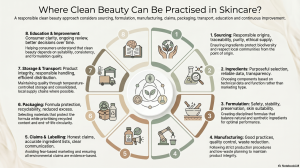
We believe the stronger approach is continued improvement in sourcing, practical sustainability, reduction of unnecessary waste, transparent communication, education, and thoughtful product development.
As a behind-the-scenes manufacturer, we believe trust is built through clarity, responsible formulation, and a willingness to keep improving.
Reference note
This article draws on dermatology commentary, retailer and editorial standards, beauty media, and Australian regulatory guidance. The references below are included for readers who would like to explore the topic further.
References
-
Practical Dermatology. “Clean Beauty” in Dermatology: A Scoping Review. July 2025.
-
Byrdie. The Byrdie Clean Beauty Pledge.
-
Sephora. Clean + Planet Aware / Clean at Sephora.
-
Rubin CB, Brod B. Natural Does Not Mean Safe—The Dirt on Clean Beauty Products. JAMA Dermatology. 2019;155(12):1344–1345.
-
Allure. Parabens Are Not the Problem. 2024.
-
Australian Industrial Chemicals Introduction Scheme (AICIS). Cosmetics and soap.
-
Product Safety Australia. Cosmetics ingredients labelling mandatory standard.
-
Australian Competition and Consumer Commission (ACCC). Environmental and sustainability claims.